

Regional In-person Training Sessions
Following the success of the DfE Local Support Offer (LSO) training sessions and the high number of requests from school and trust business professionals (SBP) for in-person training, the DfE are funding 380 in-person training sessions.

New free regional in-person training sessions for school business practitioners
✔️ 2.5 hours | practical & evidence-based
✔️ In person, face-to-face learning
✔️ Delivered by expert, experienced trainers
✔️ Real examples & scenarios to embed learning
✔️ ‘Open’ sessions – book onto scheduled regional events
✔️ ‘Closed’ sessions – organise training just for you and your colleagues
✔️ FREE (DfE funded)
✔️ Professional training certificates & ISBL accreditation points
This builds on the highly successful DfE-funded Local Support Offer training in 2024–25.
📚 Training topics include:
• Integrated Curriculum and Financial Planning (ICFP)
• Financial Planning & Budgeting Assumptions (separate sessions for LA maintained schools & academy trusts)
• Strategic Planning & Operational Leadership
• HR and Flexible Working
• Leadership and Leading Change
• Professional Development
‘Open’ training sessions which are available for anyone to book on to. This is where the training topic, date, time, and venue are set. Sessions available in all 9 regions.
Numbers are limited to 20 per session - and bookings will be taken on a first come, first served basis.
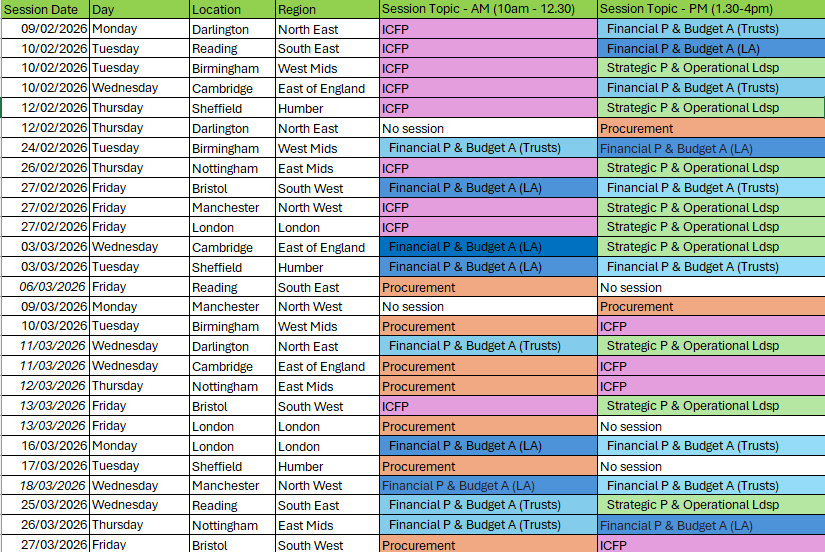
Here are the sessions available for February and March:
For open pre-arranged training in Feb & March - click here
‘Closed’ training sessions - If you would like to book one of the training sessions for your organisation and are interested in finding out more - please email: sarah.ray@isbl.org.uk.
Technical Skills and Knowledge
-
Learning Outcomes
This training will reference and help to meet the following knowledge descriptors from the ISBL Professional Standards across the Lead Practitioner Level of the Finance Discipline:
[2.31] Understands how to develop and maintain budget planning processes that are able to withstand scrutiny as part of the overall governance and approval process.
[2.35] Understands how to develop robust evidence-based income and expenditure assumptions.
[2.39] Understands national and local formulae and how these affect the school’s or trust’s allocation.
Session focusWhy does effective budgeting and financial planning matter?
What does your financial planning cycle look like?
Where can you source information to support my budget assumptions?
What do you do about Known Unknowns and Unknown Unknowns?
How do you involve the Board in medium- and long-term financial planning?
-
Learning Outcomes
This training will reference and help to meet the following knowledge descriptors from the ISBL Professional Standards across the Lead Practitioner Level of the Human Resource Discipline:
[4.3] Demonstrates a good working knowledge of data analysis approaches and systems to monitor and evaluate performance to identify opportunities/ risks.
[4.15] Can tailor recruitment and selection approaches to appeal to different candidates.
[4.19] Understands how to build and use a process of induction and assess the value it offers.
[4.27] Understands and has experience of using non-financial incentives to improve attraction and retention of staff, with consideration for alternative working practices and budgetary constraints.
Session FocusInforming organisational design including the importance of skills audits
Effective recruitment to meet organisational strategic priorities
Induction and performance management including regular professional dialogue
Implementing flexible and hybrid working approaches in schools and trusts (including flexible retirement)
Using HR performance indicators to support staff retention, EDI and wellbeing
-
Learning Outcomes
This training will reference and help to meet the following knowledge descriptors from the ISBL Professional Standards across the Lead Practitioner Level:
[1.14] Is aware of wider professional learning and CPD opportunities available to support self and other staff across the profession
[4.42] Can analyse and propose relevant CPD opportunities to meet identified needs
Session FocusUnderstanding career pathways.
Professional Development strategies
Supporting Staff in their Career Development
Networking and Mentorship
-
Learning outcomes
This training will reference and help to meet the following knowledge descriptors from the ISBL Professional Standards across the Lead Practitioner Level of the Operational Leadership Discipline:
[1.7] Understands different leadership styles and how they might create an inclusive and innovative leadership and team approach.
[1.43] Understands the value of due diligence in assessing the impact of change, innovation and growth.
Session focus
Developing and setting organisational culture and values
Leadership styles and effective leadership – including effective internal and external communication of strategic priorities and measuring understanding and engagement
Gain self-awareness of your leadership characteristics and your professional development needs.
Strengthening your preparedness and skills to lead others.
Using appropriate leadership styles (and tools) for specific situations and desired outcomes.
Efficiently and effectively developing the capacity of those whom you lead.
Develop a culture of continuing professional learning within your organisation.
Effective planning and implementation of planned organisational change.
Responding successfully to unexpected outcomes and challenges.
Capacity Building and Career Development
-
Learning outcomes
This training will reference and help to meet the following knowledge descriptors from the ISBL Professional Standards across the Lead Practitioner Level:[1.23] Can draw on relevant school or trust management information data to contribute to school or trust improvement, monitor performance and manage risk.
[2.43] Can lead on the implementation of DfE and sector-endorsed tools (e.g. VmFI, Benchmarking, SRMSAC, SFVS and ICFP).
[2.47] Can analyse data to identify trends.
Session FocusWhat is ICFP and what is its purpose.
The benefits of utilising ICFP and its impact in ensuring efficient resource use in schools and trusts.
How to accurately calculate and analyse key metrics.
The importance of benchmarking and utilising threshold data.
How to identify efficiencies and potential issues in the school’s resource use.
The importance of context to ICFP interpretation and how this influences choices and decisions.
How to use ICFP data to make recommendations to assist strategic decision-making.
How to ensure senior leaders, governors and trustees can effectively interpret and utilise ICFP data to ensure the efficient use of school resources.
-
Learning outcomes
This training will reference and help to meet the following knowledge descriptors from the ISBL Professional Standards across the Lead Practitioner Level:
[1.14] Is aware of wider professional learning and CPD opportunities available to support self and other staff across the profession
[4.42] Can analyse and propose relevant CPD opportunities to meet identified needs.
Session focusUnderstanding the changes for schools under the new Procurement Act 2023.
The principles of transforming public procurement and key challenges.
How to develop compliant and effective procurement strategies.
Carrying out needs analysis to develop robust specifications and procure effectively.
Understanding necessary and best practice procurement and contract management processes, and who to involve and consult in the procurement process.
Evaluating when and how to use approved DFE frameworks and collaborative purchasing opportunities, as well as where to get help with procurement.
Key factors to achieving best value and benchmarking considerations, including sustainability aims.
-
Learning outcomes
This training will reference and help to meet the following knowledge descriptors from the ISBL Professional Standards across the Lead Practitioner Level of the Operational Leadership Discipline:
[1.3] Understands qualitative and quantitative data analysis to aid the monitoring of operational performance.
[1.23] Can draw on relevant school or trust management information data to contribute to school or trust improvement, monitor performance and manage risk.
[1.27] Understands the purpose of risk assessment and risk management techniques, including appropriate mitigations.
[1.67] Understands and can apply a wide range of strategic planning theories and tools used to formulate short-, medium- and long-term plans for the school or trust.
Session focus
Distinguishing between strategic planning and operational leadership and how they interrelate
Fundamentals of strategic planning – vision and mission statements, environment scanning (SWOT and PESTLE analysis), strategic objectives.
Strategic implementation - Monitoring and evaluating strategic plans through KPI’s, performance data and evaluation plans
Fundamentals of Operational leadership – roles and responsibilities of operational leaders, building high performing teams and operational excellence principles.
Evidence-based decision making and leading strategic discussions
Effective resource management – Finance, people and operational efficiency.
Risk management and contingency planning
-
Learning Outcomes
This training will reference and help to meet the following knowledge descriptors from the ISBL Professional Standards across the Lead Practitioner Level of the Finance Discipline:
[2.31] Understands how to develop and maintain budget planning processes that are able to withstand scrutiny as part of the overall governance and approval process.
[2.35] Understands how to develop robust evidence-based income and expenditure assumptions.
[2.39] Understands national and local formulae and how these affect the school’s or trust’s allocation.
Session focusWhy does effective budgeting and financial planning matter?
What does your financial planning cycle look like?
Where can you source information to support my budget assumptions?
What do you do about Known Unknowns and Unknown Unknowns?
How do you involve the Board in medium- and long-term financial planning?
Soft Skills
Benefits of Undertaking the Training
All training is aligned to the ISBL Professional Standards and will help delegates to meet specific Standards.
In-depth training delivered over a 2.5 hour period with opportunities for interactive learning, peer networking and sharing best practice.
All training is developed and delivered by ISBL subject matter experts including SBPs, educational leaders and accredited training providers to ensure training is fully contextualised.
Training is delivered to MATs or regional network groups at a time and location convenient to their requirements.
Training is fully accredited and certified by ISBL.
Excellent feedback and satisfaction scores as demonstrated below:

If you are interested in finding out more information please email: training@isbl.org.uk