

ISBL Professional Standards: Employer Guidance and Resources
CONTEXT
We recognise that employers (CEOs, head teachers and governors/trustees) need access to concise information to support their decision-making processes. We have therefore produced this summary document to help guide employers through the ISBL professional standards. Through a series of intuitive resources, we hope to help employers with the recruitment, performance management and professional development of their school or trust business professionals.
PROFESSIONAL STANDARDS IN A NUTSHELL
The ISBL professional standards have been developed in conjunction with regulators, professional bodies, national associations and experienced frontline practitioners. They set practice expectations in six distinct disciplines – Operational Leadership, Finance, HR, Procurement, Estates, and Marketing and Communications – and across four practitioner levels from entry level to executive leadership.
The standards are underpinned by a code of ethical practice and five behaviours, namely agility, resourcefulness, leadership, collaboration, emotional intelligence and decisiveness.
The standards describe various tasks and responsibilities within each of the disciplines and at each of the practitioner levels and then go on to describe the knowledge and skills needed to perform the task, again by practitioner level.
Employers can therefore use the tasks and responsibilities sections to develop job descriptions and the knowledge and skills to develop person specifications. The combination can be used for both performance management and training needs analysis to inform continuing professional development (CPD) requirements, as shown below.
Professional standards use for employers
-
The standards can be used by school or trust business professionals as a framework for identifying areas of particular strength and areas for self-improvement or development.
-
The standards can be used to help identify the range of tasks and responsibilities associated with any school or trust business professional role.
The standards can be used to help identify the skills, knowledge and experience necessary to effectively perform in any given role and in a range of contexts.
The standards can be used to help employers to develop appropriate job descriptions and person specifications.
-
The standards should be used as an integral part of the performance management process.
The standards should form the foundation of performance expectations across the range of practitioner levels and discipline areas.
Consideration should be given to the difference between those performing generalist and specialist roles.
-
The standards provide a framework to assess capability and develop high-performing teams, ready and able to respond to the complexities of school or trust operations across the range of defined discipline areas.
The standards can also help to inform decisions on organisational design, structure and leadership/executive team configuration.
-
The standards underpin the development of school or trust business professional curriculum content.
The standards provide a contextualised reference point for those with relevant qualifications acquired outside of the education sector, e.g. accountancy or HR.
The standards also recognise the value of experience. In some instances, school or trust business professionals will be able to demonstrate competency and capability as a consequence of performing their role.
The standards act as a conduit between experience and qualifications and will help guide employers and school or trust business professionals to appropriate formal and accredited CPD activity.
Professional standards discipline use
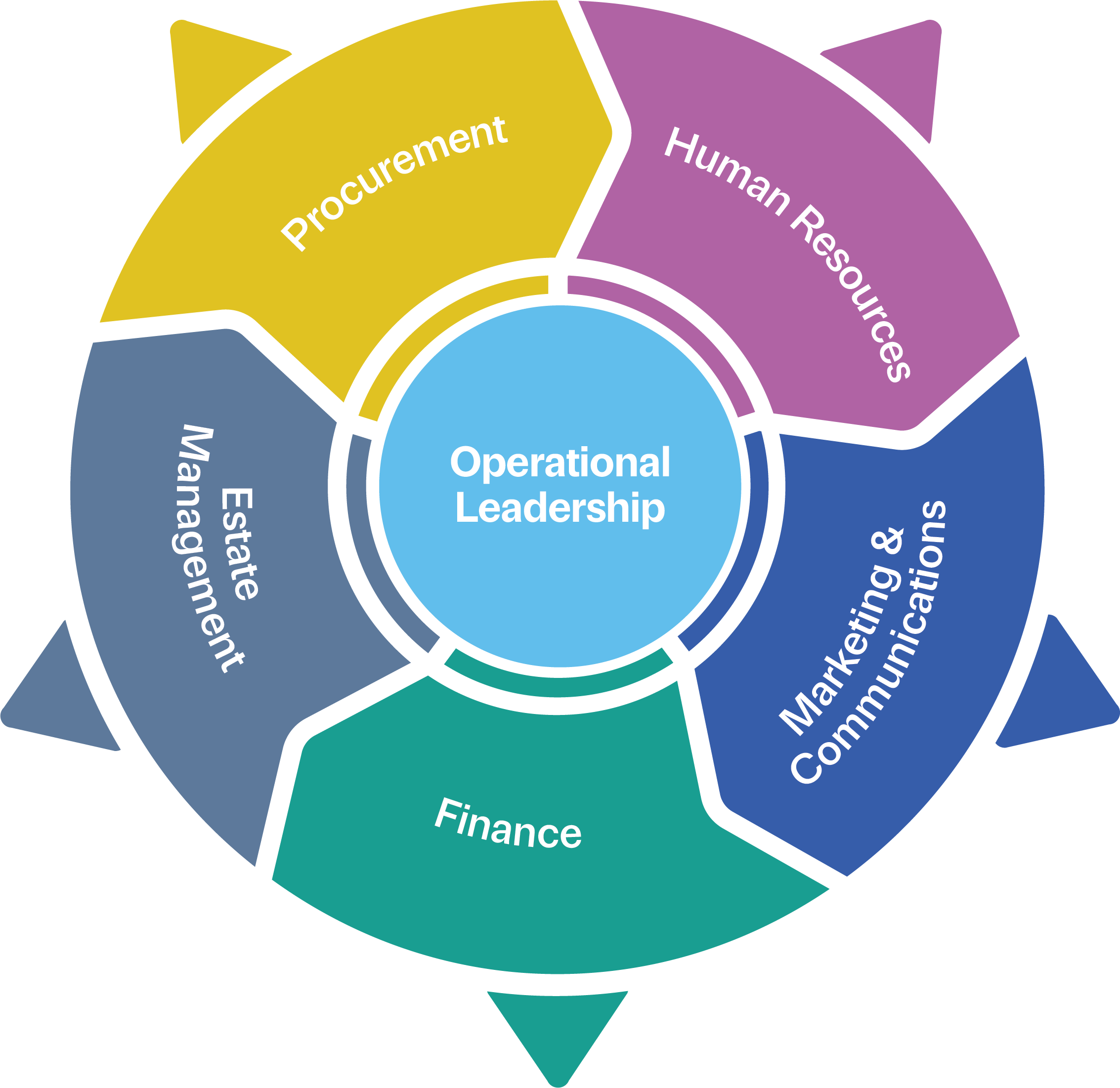
The standards are divided into five specialist disciplines with a core competency of Operational Leadership. Operational Leadership is acknowledged to be a fundamental aspect of the school or trust business professional role. Regardless of any specialism, all practitioners need to demonstrate a degree of capability in this area.
The Operational Leadership section should be read alongside the other professional disciplines when using the standards for the purposes outlined earlier. The specific discipline areas can then be used for the following purposes:
PROCUREMENT
Allows you to assess whether you have the internal capacity and capability to fulfil procurement requirements or whether you need to recruit specialist procurement expertise.
ESTATE MANAGEMENT
Provides a high-level overview that allows you to respond to the complexity related to estates. This can be read in conjunction with the DfE Good Estate Management for Schools guidance and Estate Competency Framework, which you can use to assess specific capability/support with managing estates.
HUMAN RESOURCES
Key considerations for your HR lead including what knowledge and skills are required for an effective HR administrator up to and including HR director.
MARKETING AND COMMUNICATIONS
Allows you to assess whether you have the internal capacity and capability to effectively market your school or trust and communicate with key stakeholder groups.
FINANCE
Key considerations for your finance lead including what knowledge and skills are required for an effective finance administrator up to and including chief finance officer (CFO).